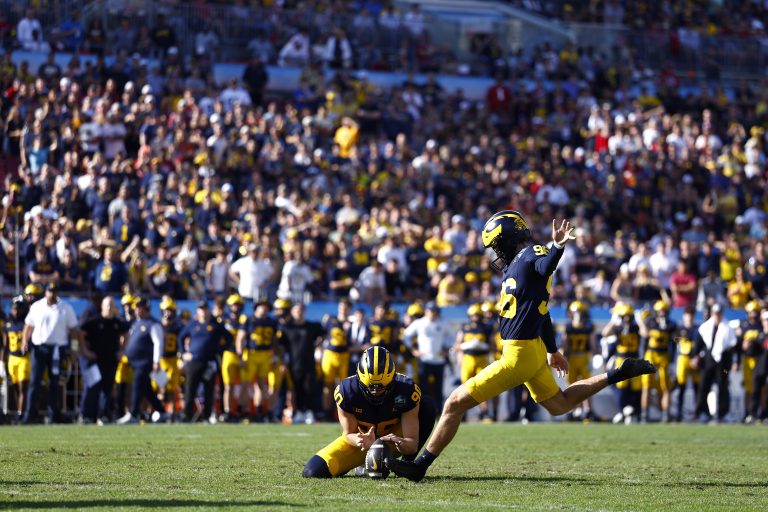
It’s been quite a redemption arc for college kickers over the last few years. In this episode, we chat with Jamie Kohl (kohlskicking.com) and learn why kickers at all levels are getting better with each passing year. From technology to technique, we get a crash course from the foremost authority on the modern art of kicking.
Key Topics Discussed
Jamie Kohl’s Journey
Jamie shares his trek from a Big 12 kicker at Iowa State to NFL camps with the Seahawks, turning Kohl’s Kicking into a hub training 75 of 96 NFL starters.
- Early hustle meant mailbox checks and family doubts; stars like Pat McAfee and Thomas Morstead helped spark success.
- NFL achievements coaching with the Bears (Cairo Santos’ 40 straight field goals) and Panthers (Eddie Pinero’s 94.3% season).
Understanding Kicking’s Rise
Dan and Ty probe how college kickers went from afterthoughts to game-changers
- Video analysis—VHS to iPhone slow-mo—sharpens technique with pinpoint precision.
- Specialist coaching at camps and colleges builds snap-hold trust for clutch, long-range kicks.
Tech and Tools Driving the Surge
Technology—advanced cameras, data-driven strength conditioning, etc.—partially behind kicking’s rise
- Broken-in footballs and mudding boost flight, moving past stiff, new balls of old.
- YouTube and camp rivalries open access, luring sharper athletes who train smarter online.
The Mental Edge of Kicking
Kickers face singular pressure, and Jamie explains prepping teens for it—melding mental toughness with team bonds.
- Eddie Pinero shines as a “gamer” loving the spotlight; others thrive loose among teammates.
- At 17, it’s distilled: athleticism, technique, and a warrior spirit to weather tough days.
Special Teams Coaching Shift
Special teams coordinators shape the surge, with NFL pros like Chris Tabor excelling in detail, while college punt rules ease prep.
- NFL punt requires precision (gunners only release early); college free releases cut practice time.
- NCAA rule shifts let analysts coach on-field, reshaping resources—some split duties, skipping dedicated coordinators.
Highlights and Insights
From VHS to Viral
New camera technology in iPhones, which can shoot at 120 frames per second, is having a greater impact than you might think.
Laces Out Lessons
An Ace Ventura nod fuels debate: Is it true that laces mess with long kicks?
Wind Wars in Chicago
Kicking at Soldier Field battled wild winds—12 mph right-to-left flipped to 18 mph left-to-right off the lake.
Couch to 30-Yarder
Jamie teaches Dan and Ty to kick a 30-yard field goal: start with soccer balls, warm up, and spare those “old man hammies.”
Implications for College Football
A New Era for Specialists
Jamie Kohl’s story reveals a college football truth: kickers are now linchpins, not laughs, thanks to camps, tech, and coaching. With NFL wins tied to his system and new stars constantly emerging, kicking’s rise ups the stakes.
Important Links
A fan of our college football podcast? Leave us a rating and review, and don’t forget to subscribe or follow so you don’t miss any of our podcast episodes:
Apple Podcasts: https://play.solidverbal.com/apple-podcasts
Spotify: https://play.solidverbal.com/spotify
Amazon Music: https://play.solidverbal.com/amazon-music
Overcast: https://play.solidverbal.com/overcast
Pocket Casts: https://play.solidverbal.com/pocketcasts
Podcast Addict: https://play.solidverbal.com/podcast-addict
CastBox: https://play.solidverbal.com/castbox
Our college football show is also available on YouTube. Subscribe to the channel at: https://www.youtube.com/@solidverbal
Want to get in touch? Give us a holler on Twitter: @solidverbal, @tyhildenbrandt, @danrubenstein, on Instagram, or on Facebook. You can also find our college football podcast out on TikTok and Threads. Stay up to date with our free weekly college football newsletter: https://quickslants.solidverbal.com/subscribe.
College football has been our passion since we started The Solid Verbal College Football Podcast back in 2008. We don’t just love college football, we live it!
Episode Transcript
Welcome to The Solid Verbal.
The Solid Verbal.
Come after me!
I’m a man!
I’m 40!
I’ve heard so many players say, well, I want to be happy.
You want to be happy for a day?
Eat a steak.
It’s that woo-woo!
And now, Dan and Ty.
Dan Rubenstein, at long last, we get to do this episode, my man.
Yes.
I’m very excited for us.
I’m very excited for you.
I’m very excited for the listeners.
I have been waiting to do this episode.
I will check back on my phone.
October 17th, 2024.
What has that been?
Four months?
Four plus?
At least, yeah.
Four months that I have wanted to do this episode.
The origin story behind this is, at some point, you and I had a message going on Slack about how college kickers are no longer a punchline.
No.
College kickers have become something of a secret weapon.
At least some of them have.
And if you go back through and look at data, many articles have been written charting that there are more 50-yard field goal attempts now than last season, than the season before.
Something like two and a half times more 50-yard field goal attempts than there were back in 2016.
Clearly, there is a trend here, and clearly kickers are getting better.
And we wanted to put an episode together trying to understand why.
Why is that the case?
Now, we can make some assumptions.
We make those assumptions all the time with other positions and other sports.
But we thought maybe today we would take a little bit of time to truly understand why that is the case.
And we’re not bright enough to know ourselves, so we had to bring in a guest, an actual expert.
Although I have theories, they’re probably not going to work out as well as somebody who actively coaches an overwhelming number of kickers, high school, college, and pro.
So, with that being said, today’s episode is going to be, in effect, The Solid Verbal kicking special, the kicking extravaganza.
We’re going to talk to Jamie Kohl from Kohl’s Kicking Camps to understand what it is that he does, first and foremost, and what he has seen over the last 25 years or so to get us to this point where now kickers are a little bit more consistent, certainly not the punchline they were, at least on the collegiate level, out on social media and whatnot.
I’m excited to learn a little bit more from Jamie.
Understand the art of the perfect kick.
Hit follow, hit subscribe so that you don’t miss any of our episodes moving forward.
Of course, Verballers.com is where you can go for more information about ad-free episodes, bonus content, things of that nature.
But Dan, this is like the ultimate off-season episode for us right now.
Like, I’m so excited to talk about this.
It’s also a really important episode, the more I think about it, in terms of hoping to strengthen our individual relationships with current and future kickers for Penn State, Notre Dame, and Oregon.
That’s right.
That like, over the years, and this is because we are the most average fans, over the years, we have rooted for our teams with kickers who, when you see them trotting out, you’re just like, there’s just no chance.
There’s just no shot.
And you have no faith in them, and you have no faith in the process, and you’re just like, how can this coach, and this is all capital letters, not find a guy.
Right?
That like, how do you not find a guy who can make a 40-yard field goal, who can make a 35-yard field goal?
And I think this episode will do more to put that world into three dimensions, where not only is it harder, but there’s more that goes into it than we are realizing, and that we will respect the struggle and the efforts by kickers as they try and sort of help their teams win football games.
But I don’t know if I’m going to get there today in terms of forgiving all past kickers that have let me down.
But I think it’ll be a healthy step for everybody listening and for the two of us to say, wow, there’s a ton that goes into it, and it’s cool that they’re getting better and that there are more long kicks being nailed.
Let me pay a little bit more respect on the names of kickers.
Absolutely.
I think that’s a healthy, mature thing that we are currently undertaking.
Well, why don’t we leave it there?
Why don’t we get started with our conversation?
We’re pleased to welcome in Jamie Kohl from Kohl’s Kicking.
Sir, welcome to the show.
How are you?
Doing great, guys.
Thanks for having me.
So, before we launch into our 4,000 questions that I think Dan and I have about the kicking industry and what you do, can you give the audience a little bit of background?
Tell them what you do, who you’ve worked with, things like that.
I’m from Wisconsin originally, from the Milwaukee area.
Went to a couple different camps in high school.
Had a good day at the University of Wisconsin-Madison’s camp.
They recruited me some.
The defense coordinator took the job at Iowa State.
I got a full-ride offer after my senior season.
Took a scholarship at the time.
There wasn’t NIL or the portal or anything else.
So, very excited to get a full-ride scholarship in the Big 12.
Took that opportunity.
Started for four years.
Parlayed that into a training camp contract with the Seattle Seahawks.
Played in a couple preseason games.
Basically, I kind of figured that I was really good, but not good enough to make the NFL.
It became clear to me.
So, I decided that I wanted to become a teacher coach.
Started working towards that degree to get my teaching certificate.
And in that time, I needed a summer job.
My brother, Andy, was a punter at New Mexico State.
And he also had a cup of coffee with the Pittsburgh Steelers.
And my dad, John, helped kind of launch these camps.
That was in the year 2000.
The year 2000, we started off very small.
We lost money the first four years of our operation.
And just really, it was only because we loved it that it became successful.
Business-wise, it made no sense.
I actually had my mom and my wife, the two women who are most important to me, sit my dad and I down and ask us to stop doing these camps.
Because they’re really not working out.
So, we did a lot of crazy things in order to make it successful.
And in the years that followed, we started to work with some top athletes.
We went down to Texas.
One of my college coaches had a great high school program in Texas.
And at that point, we met Thomas Morstead, who is 38 years old and still doing it.
He was in high school at the time.
And he ended up becoming one of my best friends.
No one would have thought he would be the highest paid punter in NFL history.
He kind of rode this journey together with us.
Then I had a bunch of people kind of rally around what we were doing.
Luke Radke became a full-time employee with us.
Bret Culbertson is my video guy.
He became full-time with us.
They both had great college careers.
And then we kind of grew into the snapping division.
We connected with ESPN, Under Armour.
Did a lot of different things in the following years.
And really, again, where we broke into the NFL was with Morstead’s first class.
Pat McAfee, Thomas Morstead, Tim Masthay were our three guys.
And they were all really loyal to what we were trying to do.
Obviously, very, very good players.
Pat was a superstar, both on the field, off the field, obviously.
And it was kind of cool.
We kind of got that reputation going between 2010 and 2020 before the NCAA changed rules.
I think I led something like 130 different D1 college camps.
So, in June, I would literally jump on an airplane.
One summer, I did like 21 different camps.
And so, we were hustling it.
And in that time, you either earn respect or people will think you’re not – if they don’t think you’re the best, they’re not going to hire you.
And especially in today’s society where you can get anybody anytime, we’ve really tried to make it the gold standard.
And so, what that all has parlayed into now, 25 years later, is I got hired in the NFL after the double doink in Chicago.
The Bears brought me in, and I coached for three years and very happy with the success my guys had there.
We broke the all-time punt record, club record, and then made 40 field goals in a row, which is third all-time in NFL history that I never thought was going to be even close to being possible in Chicago because of the wind.
I mean, Robbie Gould was an amazing player.
I didn’t know if his records were beatable, and if you look at what Cairo has done, he’s done it about three or four times now, reestablished the team record in field goal percentage.
After the Bears fired Matt Nagy, I got hired in Carolina with Coach Tabor, again, brought me along.
Eddie Pinero led the NFL in field goal percentage, 94.3%.
And the funny thing is, I was looking up field goal percentages right now all-time.
Eddie’s third in NFL history, you know, and it’s kind of cool to see.
So that’s what I’ve been doing on top of the camps.
With the camps and overall reach in the last year, we looked at it.
There’s 96 starters in the NFL.
So there’s a kicker, a punter, a snapper.
Are you guys with me on that?
Each team has one. 75 have come through our camp.
So it’s kind of a deal where we have a fraternity.
We try to see guys when they’re in high school.
That’s our job with ESPN and the rankings.
And trying to help with the recruiting aspect when we talk with college coaches because they know that we see most of the top kids continue those relationships in college.
And then, obviously, like, I’m going to Indy tomorrow.
You know, I would say 75% of the participants are guys that we’ve worked with that are going to be kicking, punting, snapping at Indy.
So it’s something that we’ve been doing full-time for 25 years, started off super small, and has given me a very unique viewpoint of what has happened in the industry, what is happening in college football, what has happened in the NFL.
And, you know, seeing kind of the athletic improvement in kicking, which you guys have already kind of identified, has started to happen.
I guess we come at this from the perspective of fans watching the games, thinking to ourselves, oh, my God, it’s like kind of wild that college kickers are nailing 50-plus-yard field goals with ease.
And if you trace it back, there’s been a huge jump just in 50-plus-yard field goal attempts over the last season.
And there’s been a clear trend throughout, let’s say, the last 8 to 10 years, basically, of college coaches trusting their kickers more in some of these higher-leverage situations from farther away, etc.
The obvious question for me is, like, what are you feeding these guys at these camps?
How is this happening?
But to what do you attribute the leap that we have seen as fans from afar in just the quality of the kicker out there on Saturdays?
Why is this happening?
I don’t think – I think it would be naive to try to attribute it to one thing.
Sure.
I think that there’s a lot of different factors.
Let’s start with just some baseline things.
You know, like I talked about in the year 2000 when we had our first camps, I remember doing a camp close to us in Minnesota.
And we had a VHS tape, and we filmed the kids.
And some of the steps and some of the techniques and some of the things you saw, we actually looked at maybe three, four years ago.
And it was hilarious because there were so many different crazy ways that guys were attacking the ball, that they were taking their steps.
They didn’t even know what they were doing.
And the reason I brought up the video equipment was that was the first time they saw themselves on film.
That was one of our biggest selling points is, hey, you can see yourself, and this is what you’re doing.
Now, with advancement in technology, not just from our camps, but just in general, an iPhone has a shutter speed of 120 frames a second.
I mean, you can look at some detailed imaging, and if you know what you’re looking for, go to like our YouTube channel, and you see a bunch of pros doing it.
And the information available from a technical perspective is so much better than what I had when I was a player and even what guys had even 10 to 15 years ago.
So being a teacher and an educator, I kind of put together a curriculum.
And, you know, we have a PowerPoint, we have different things from a technical standpoint to refine the process and basically limit margin for error.
So that explains a little bit of it is, is guys technically know what to focus on in order to hit an A ball.
Now, does that make the A ball go as far and high and clean as what they’re doing right now?
Well, I would argue that’s a part of it.
Well, the next part, in my opinion, is the coaching has gotten so much more sophisticated as well.
With the sharing of information, back in my era, guys would give you a bag of balls, tell you to practice, and then come over for the team reps when you’re ready.
And then they’d give you some odd jobs throughout practice.
You’d do the weightlifting, and, you know, you’d do some stuff.
But it’s not like today where there’s more money available for coaches.
A lot of college coaches have a specialist analyst, GA, whatever they want to term it.
They have a lot of different terms now that are creative in college football.
They have someone that’s generally working with the kickers, punters, and snappers, watching a rep count, making sure that the practice is being filmed, that they can view it.
And, again, just the educational environment around a practice has changed dramatically for the specialists.
One of the things we saw a lot from maybe the 2010 to 2020 era was just a tremendous amount of injuries that were happening.
And I really think that that was related to the strength and conditioning, not working with the actual coaching that’s going on.
And I’ve always used kind of an easy way to think about it is if you’re burning out the weight room or the running, then the kicking has to be less.
If you’re both high here, that’s where now the injury really starts to become a potential risk.
So being able to navigate rep count, practice count, practice reps with the strength coach, getting them on the same page, building in rest and recovery.
You guys have all seen the, you know, the different technology they have to track sleeping.
Quite frankly, these kids eat better.
You know, I’m hitting on a couple different topics here.
But I do believe that the coaching has greatly improved.
So that will also lead to better snaps, better holds, because guys, again, know technically what they should be doing, what it should look like.
And there’s putting in focused, detailed energy, because quite frankly, that’s a huge part of 50 plus field goals is the snap hold now cannot just be an average snap hold.
It’s got to be very well.
The tilt, the angle of the ball, okay.
Forward, back, right, left.
Laces one way, laces another way.
Depending on the wind, depending on the conditions, that will affect, especially on longer kicks, where the ball moves the most is the last 10 to 15 yards as it loses velocity.
Now it’s much more able to be moved from the wind.
So therefore, aiming and getting reps, you know, in that environment, that’s a big deal.
Especially like in Chicago, man, we wanted to go down to Soldier Field and get those reps.
And we’d drive an hour and 15 minutes on a Friday just to get those reps with Eddie and Cairo so that they were ready to go and felt good in that environment.
So again, the coaching, from my perspective, we’ve done clinics with a lot of different college coaches, a lot of NFL coaches.
The sharing of information has made everybody a little bit better.
I would compare that to like high school weightlifting programs.
Back in the day, man, like you’d look at a conference and two or three schools were way up here and you could just look at their kids and you’re like, man, what are they doing?
What’s going on?
And now I would say everybody else, it’s just kind of here because they’ve all shared from really good coaches.
It’s tough to keep good information in-house.
I would argue, you know, again, the technology improvement from a video breakdown and coaching and then the coaching standpoint at the collegiate level.
And that has improved the snap hold.
Another key component to this, and I know this is one that people probably don’t want to hear.
I would argue that the ball technology is better as far as finding the types of footballs that will fly in-game better.
I remember playing in college and I had to fight my equipment manager.
I loved him.
Good guy.
But he was just trying so hard to abide by the rules that the conference says it had to be a brand new ball.
And you couldn’t, well, it didn’t take you long as a kicker to figure out.
I really liked the sun beat in, sweated on two-a-day footballs that have been used for three weeks.
It conforms to the bladder and you get better compression.
It just flat out flies better.
It’s more natural.
Think of it like this, a brand new NFL ball.
The leather is very firm or a college ball, whatever.
I’m just talking a brand new football that’s used in a game.
It’s boxy.
It does not conform to the bladder.
So when you hit it, it doesn’t create as much energy to be able to come off your foot clean.
And the compression is not as uniform.
And so that makes kicking longer kicks obviously harder.
The ball doesn’t carry.
I would argue now that the mudding that goes on the pregame, the ability to use broken in footballs.
And some teams were really good about it.
I remember watching some football games.
I’m not going to name schools, but, you know, on TV in the mid 90s or I’m sorry, 2000 teens, that era.
And they were had they had way broken in footballs and then their opponents didn’t.
And it’s just like, again, it’s a cat and mouse game of trying to trying to find a way to bend the rules without without doing it too much.
And I would argue now college and the NFL has figured out, hey, let’s let the players have their best performing footballs.
Not only quarterbacks and receivers, kickers, punters and everybody else.
And I know that some football companies now, they’ll come and meet with schools.
And the craziest thing to me is the aerodynamics of footballs are not uniform.
NFL balls are different shape than some of these college balls to maybe help guys with smaller hands.
And different companies have different they all got to be within a certain range.
But there’s variance within those range ranges.
And we have actually looked really into footballs and tried to understand football technology.
And to me, it’s it’s crazy.
Again, why I get it.
Maybe it’s just it’s flat out economics.
Different football companies want to have a slightly different brand that they can market to, you know, punters or market to quarterbacks or market to receivers.
Or, you know, like if you’re a coach and, you know, you got a guy with small hands.
Oh, wow, we want that one.
But at the end of the day, the way the product performs is dependent on the circumference and the size of it.
And being able to really, you know, find find the maximum type of football from a broken in and size standpoint that will travel.
That is one of the things.
And in the NFL, they have made, you know, they started off in my era.
We were kicking brand new footballs off from the 30 yard line.
Well, those things, again, were boxy and you could barely get it to the goal line.
And then they wanted touchbacks.
Well, what did they do?
They they they moved up five yards and then they gave the guys the ability to have broken in footballs.
And that’s a big reason, again, why the ball now is is traveling so good at both levels is they have done a better job of allowing actually better performing footballs in games.
I know that one’s not sexy, but that’s right.
The next thing, in my opinion, is I would argue from our camps, we have created a system that is competitive and inspires good athletes to like want to go home and train.
If, you know, before we kind of put this thing together and not just us, there’s others.
No, no one person created this.
It’s but we, you know, we were a part of it.
And so, like, if if I’m a kicker and all my I work all year round on the field by myself for, you know, 10 or 11 games on the weekend in fall, you know, that’s that’s cool.
And that’s fun.
But it’s not super, super motivating for the rest of the year.
Well, now, if I can go to these camps and especially in today’s era where everybody wants to brag on social media how good they are and go to camp and now I’m going to work my tail off because I want to win this camp.
I want to beat that guy that beat me the previous.
So that competition at an early age on a national level has made it that guys guys really gain an identity and they put goals in place.
And I would argue that he has a huge impact on attracting better athletes because good athletes are always competitive, in my opinion.
Right.
And nobody wants to finish second.
And they’re all kind of.
So I would argue that that for the last 15 years has motivated maybe better athletes to be attracted to kicking that otherwise maybe they would do it for their high school team, but they’re going to be focused on baseball or basketball or hockey or whatever else they’re doing.
But now this pathway to compete, to put it on the line per se, I think that has attracted better athletes.
So that’s been a big help as well.
Another thing that I would attribute would be the nutrition.
I mean, these guys look different.
Part of that might be the genetic better athlete part, but the nutrition aspect, the recovery aspect, and then the strength and conditioning people are much more tuned into taking good athletes and making them better.
I think in the early years, strength and conditioning could get everybody stronger, but it would not necessarily translate to the football field.
I think that through trial and error and through advancements, I think everybody’s understanding the speed strength ratio is an important one.
It’s good to be able to move a lot of weight, but if you’re losing speed, speed is the primary creator of force.
And so, you know, how can I move faster?
That’s probably the primary question.
And now if I can put on weight and still move, you know, faster now, now that’s just incredibly great.
But, but the, the, the focus on speed and flexibility, I think that that’s, that’s, that’s an important thing that, that is probably become more relevant in the last 15 to 20 years.
And, and I think people are still trying to, you know, figure out the best way.
I don’t think we’ve achieved it yet.
Right.
Because you could go to a couple of different strength and conditioning conferences and see a bunch of different.
You know, people that were very, very respected and very, very good at what they do.
And they’d have contradicting ideas on certain things.
So I think they’re still trying to figure that out.
But to me, those are probably the main reasons why you would see that.
I think that again, coaches are creatures of habit in order to get those game opportunities that you guys have talked about.
I think the players have to be able to show in practice that they, that they can actually perform it.
And so again, having guys who, who, who, who are putting all these things together to earn that trust.
I think that that’s, that’s, that’s part of the reason why you’re seeing the increase in, in field goal percentage and field goal attempts.
And especially from beyond 50 yards where they are more of a weapon.
I would argue that those are, those are some of the reasons and I’m sure that I’m missing a couple and we can expand on it.
I know I’ve talked a lot here, but I’ve just tried to give you some background.
Definitely.
One of the things that’s always been fascinating to me is the special teams coach, the specific responsibilities of a special teams coach are very different than other coordinators, than other position coaches in that they’re responsible for a much more varied type of play, right?
You’re talking about coverages, you’re talking about kickoffs, you’re talking about block teams, you’re talking about different kinds of kicking place, kicking kickoffs, punts, field goals.
There’s a lot under that coaches, that coordinators per view, have special teams coordinators gotten better.
Do they go to camps to learn about snaps and holds, right?
Like they are, you know, they’re math teachers, they’re English teachers, they’re social studies, they’re history teachers.
Like how has the professional development of special teams coordinators, even the last few years evolved, if at all?
Yeah.
Great question.
So when I’m around who I think is one of the world’s best with Chris Tabor, he was with the Bears.
I mean, he’s been in the NFL for 15 years.
He’s got all the accolades finished, you know, a head coach, interim for a couple of weeks.
And I see the level of detail of focus of film preparation.
I am blown away and I am still an infant when it comes to understanding space, techniques, leverage, being able to cover.
It’s literally the most dangerous play.
Anytime you’re covering 40, 50, 60 yards on kickoff, on a punt, punt return.
If you’re not solid in PAT field goal protection, holy cow, it gets exposed like yesterday.
And again, you know, as fans, you only notice the, the absolute, uh, disaster when it goes wrong.
Yeah.
Well, yeah.
And then at the NFL level, the big thing is, is trying to navigate a 53 man roster.
Who’s up, who’s down, who’s injured, who is sick, who, cause you’re limited on spots.
And that really starts to become, uh, another, uh, I would call it discipline.
I mean, that is, that is an art in and of itself.
And I, I feel like Tabes is as good as a general manager when it comes to understanding the roster, understanding who can we plug in here and still execute our game plan.
And, and, and, and, and so when I, when I, when I look down now the trickle down of what at the highest level, it looks like, I would say that there are some tremendous differences between college and especially high school.
In my opinion, I feel like the punt game in college has changed so much because of the rule differences.
And I don’t know if you guys are familiar with it, but in the, in the NFL, at the snap of the ball, the only two people that can release down the field are the gunners.
Everybody else has to wait until the ball is punted at the collegiate level at the snap of the ball.
Everybody can free release down the field.
And therefore that’s why you see a lot of rollouts.
You see a lot of, a lot of different variances because you can free release and get a bunch of people downfield.
You can move and it’s not necessarily confined to a pocket.
So therefore you don’t have to coach protection nearly as well.
You don’t have to coach coverage quite as well because quite frankly, it’s like throwing darts on a dartboard.
You’re going to hit because you got so many guys in coverage returns are less.
Don’t have to teach your snapper how to protect.
Don’t have to teach your punter how to pump a hang time and distance or direction.
Cause he can roll out and slap it on the ground.
Right.
And it’s created a product that basically has made it that mandatory that you coach punt for 10 to 15 minutes a day.
So now you coach punt five minutes a week.
So it’s given coaches more time to spend on offense and defense, which they love, but it’s made the actual coaching and the greatness of it a lot easier.
That average Joe can come on in and maybe be able to coach up a punt team.
Once you learn a couple of tricky dickums where you, you know, a couple of motions, you keep a defense honest, you have a couple of fakes and literally you don’t have to practice protection or detailed communication and coverage and everything else.
Like you see at the NFL level.
Well, some people like it and feel like, oh man, we can do more fakes and this and that.
I feel like it’s less exciting because it limits return.
It limits the, uh, the, you know, any, you can take anybody that can snap.
You can take guys that cannot hit spirals that turn over and hit, you know, directions and takes away some of the art of that.
And again, if you’re a really good coach, you would want to have the most difficult conditions because that’ll separate you from your opponents and give you an edge.
So I understand both sides of the argument.
When you talk about special teams coaches, I would say at the, at the NFL level, they’re, they’re unbelievable because they have to be able to execute the punt play punt is, is more than a third of special teams coach.
You know, you got field goal, field goal block punt, punt return, kickoff, kickoff return.
Well, the big one is always punt at the NFL level on where in college.
Now I would say again, because of the rules, because of the way it’s evolved, because of the, some of the things that they’ve done.
I think punt is obviously very important.
It’s still the first way to get you fired, but I would argue that a lot, a lot of teams are going away from, uh, I would say it’s half and half where they have a, a dedicated special teams coordinator to your point.
And then where they kind of have a, by committee, this coach is in charge of punt.
This coach is in charge of punt return.
This coach is in charge of this.
The NCAA has changed rules in the last couple of years to allow analysts to actually coach on the field.
And it’s really up to the head coach, how he wants to distribute his allocated resources to his coaching staff.
So if you have X amount of dollars and you’re going to pay your 10 coaches, this, do you want to pay a special teams coordinator?
Do you want to pay an extra linebacker coach?
And I know I’m giving you a long answer, but it’s, it’s not an easy, “has it gotten better?”
Has it not?
I would say it’s changed because again, I think punt is a huge catalyst, the punt punt punt return game to the collegiate game.
And then obviously what they’ve done with kickoff with the fair catches, the getting rid of the wedge, you know, the NFL has a different kickoff than college.
It’s been a constant, like our whole country or our whole world last 10 years.
It’s like, man, it is just changing so fast.
It’s, it’s hard to keep up with quite frankly.
I also assume that on a very real level, I mean, you and your coaches and your team, you’re teaching technique, right?
You’re, you’re teaching best practices.
I assume you’re also a major part of your job is you’re a psychiatrist, right?
This it’s a lot of it.
It’s between the ears.
It has to be like, like there’s no other position, maybe in sports where you get a TV shot of a specific player at a specific position on the sideline with announcer saying, man, I wonder what he’s thinking.
I wonder what’s going through his head as they’re warming up on the sideline.
What, what is like, I know this is, I’m going to try to be as specific as I can.
Like, how do you prepare a 17 year old’s mind, hormones raging?
They’re about to go off to live alone for the first time.
And they’re playing a position in which they are largely isolated from their peers.
And you are tasked with sending them off with like a clear mind, which is like, to me, it sounds impossible.
I have a six year old.
I couldn’t even imagine doing that with like a 17 year old.
Like, how do you send off a kid mentally for what’s ahead of them?
Well, that my friend is a, that’s why you got paid the big bucks.
Yeah.
So I appreciate you understanding all that’s at play here because there’s a lot of naive kids.
They’re like, Oh, I want to be the hero.
I want to be hit that game winner.
I want to.
Yeah.
There’s two sides to the coin and you can’t play this position for an extended period of time and not experience both sides.
And that’s again, where, uh, yes, the ability to, uh, focus your attention to, you know, I guess you could say, exclude the internal, uh, external environment.
You know, right brain, left brain, some of these things that I’ve talked to a lot of people are way smarter than me to try to, uh, get athletes to, uh, to perform, man, that’s real.
And, and basically I, I like to, I like to keep things as simple as I can when I’m trying to teach.
Um, I think you got to have three things.
I think you have to have the athletic talent to be able to compete.
You’re with me on that.
You don’t need to have the strongest leg, but you got to have a leg that if a whole bunch of grandparents are in the stands, they could figure out.
Wow.
These guys are very close or, you know, like if one boy is clearly farther and way better to be at the highest level, there can’t be a different, there can’t, there can’t be that much difference on anyone.
I think in the NFL, you know, we had the, the line, the good from line and, and Cairo is known as a consistent ball striker.
He is not one of the strongest field goal legs in the NFL.
And you know, like Harrison Butker, another guy we’d worked with, he has great range.
He could go still the good from line between those two and most games is probably five to seven yards.
Yeah.
And that’s maybe the top to the middle.
You know, I’m not talking like, there’s just not that much difference.
They’re all very similar.
I know the kid down in Dallas is smashing balls, but you know, it’s probably five to seven yards between the greatest athletes.
So you got to be in that realm athletically.
Okay.
The second thing is you have to, uh, have the technique in order to call on that athleticism.
I don’t think you can last for an extended period of time.
I say 25 Sundays in a row.
I don’t, you know, when you include preseason, regular season, you go into the playoffs, you have 25 different movies to repeat.
And if you got just a big leg and no idea about fundamentals, technique, balance, and being able to make it in a non competitive environment, it’s not going to hold up.
Right.
You know, it’s, it’s not like, you know, and practicing free throws on your own, you’re 50%.
And now you’re going to go into games and you’re going to hit 80% free throws.
That’s just not reality.
So you have to have a baseline leg strength technique.
That’ll be able on every day.
You got a good shot of putting the ball through the pipes.
The last thing is you have to be of a, a DNA or a mentality where you are legitimately a mental warrior.
You have to enjoy that spotlight.
And I would use like Eddie Punero as a perfect example.
My greatest job in coaching Eddie was to get him to practice hard because game day, I knew Eddie loved, loved the spotlight.
He was a gamer.
Yeah.
Absolute gamer.
He loved it.
And that’s a gift.
That’s a gift I can’t coach.
We can work on, we can work on, but every athlete has, you know, in the, in the, in those three realms that I brought up, I think they all are probably a little different.
And what makes a great player is probably being solid in all three.
And then, you know, just being able to handle situations that’ll come at you as a kicker, because that’s, that’s a big part of the long-term success is situational success.
You know, and, and like in Chicago, we were fortunate.
We, we kind of protected, uh, on cold windy days, like, “Hey, fourth and two, let’s go for it.
Let’s not expose our guy.”
Right.
To, uh, to lose the juice that he has.
So handling the mental aspects of a player, huge.
And as a coach, my main thing is I want to provide the proper amount of stimulus where he’s being challenged, not overwhelmed.
And now that’s hard for non-amateurs to really like, like if you’re talking about coaching, that’s hard for, you know, your Average Joe that, you know, watched a couple of kicking manuals and now is out there trying to work with guys versus someone that like myself, that’s played the position, gone through the position, evaluated the position, and now coaches the position where there’s only one guy that has to perform for you.
Um, man, those are some things now that I think when you’re talking about the great ones is keeping them confident, keeping them the proper amount of stimulus and trying to have them be successful.
It’s definitely hard, though.
When you’ve identified it properly, that’s what separates the guys.
You talk about guys, I mean, Eddie Pinero, and I’m sure he’s one of many that, you know, they’re locked in, they’re gamers.
They love the opportunity.
They love the, the limelight.
They love the moment.
You see that shot of the kicker on the sideline warming up.
And a lot of the time, you know, nobody’s talking to them.
Nobody’s really bothering them.
They’re really locked in there.
They’re sort of focused and ready to roll.
Do you come across some kicking personalities where it’s almost the opposite?
Like they thrive being loose.
They thrive that, you know, their, their shoulders are down.
Their jaw is relaxed, right?
That because they’re around people that they’re actually going to be better in the spotlight because they feel less on their shoulders, that they like to joke around before big moments, that they like to be with the guys before moments.
I know, you know, there’s obviously every personality for every sport, every position.
Are those, are there those guys that are better loose?
A hundred percent, a hundred percent on that.
And if I were like, what I’ve always tried to do is have guys and if two guys are even, I’m going to choose the player who will relate better to the locker room, who will be someone as a coach, you’re going to want to be around every day for a couple hours.
People that inevitably have friends on the team and are liked and respected amongst their teammates, loved.
Those guys, I think have a better lifespan because they will handle the bad times better.
The bad times are coming, man.
Yeah.
Flat out.
They’re coming.
Okay.
Whoever you are, they are coming.
Now the separator is how can you shorten the bad times and how can you overcome them so that, so that you can just get back on your horse quickly.
And I think people that are, you know, in, have, have, have good relationships amongst their teammates.
Now, now don’t, don’t get it twisted.
Like on a Sunday afternoon game winner, you got, you got to lock in and you’re going to have to probably spend some alone time getting your swing, right.
And trying to clear your thoughts.
That does not mean that you’re not, well liked by your teammates and you, you know, and you might even get a pat on the butt or whatever, but just like a quarterback going in on the last play, there’s not going to be 10 guys telling them we can do this.
It’s going to be, man, do your job.
And we got you, you know?
And so, so again, I think that, that, that relationship amongst teammates is great.
Now there have been some good ones now.
They’re so narcissistic that they’re just, I think they’re above it.
And that arrogance actually in a certain sick way, probably helps them through some of it.
Sure.
Uh, but, but again, when it gets bad, that’s when people come for their head because they, they don’t like them.
And the, and the, and the nothing infuriates a group of grown professionals more than they work hard for three hours and they put their team in a position to win.
And then they lose, especially in the NFL level, all that comes with losing with the media and just every it’s, it’s painful, man.
It’s painful.
So you want to have friends around you.
Well, I guess what I take away from this, I mean, across the board, athletes are just better now than they were a decade ago.
That seems to be a continuing trend.
That’s not new news to anybody listening to this, but information seems more readily available.
You’re able to be a little bit more consistent with teaching technique.
There is some element of the equipment knowing, I guess, which equipment to use, when to use it with respect to picking the right balls and whatnot.
But I was hoping maybe you could explain a little bit more about the video analysis, because that’s one of the things that I’ve read a lot about and trying to research for your appearance here on the episode.
What specific insights are you pulling from video?
Be it from an iPhone, some other camera, something that is sent to you.
What is it that you are looking for being so you do know what you’re looking for?
The whole point of video is to understand the athlete, who they are.
I would say that from our long video breakdowns over the years, we’ve started to come up with ideas about body types, about flexibility ranges, about movement patterns, about how each athlete produces their kick.
And when I was younger, I probably tried to more streamline it.
And then I’ve had a lot of good coaches who have helped me.
A lot of times there’s a saying in coaching, trust your eyes.
And when you start looking at different people and different ways to be successful, look at major league pitchers or batters.
If one guy would come up there and say, you have to hit this way or pitch this way, I think they’d be laughed at by the majority of baseball because people start to understand we all move different.
I’ve started doing some study.
I mean, some guys, for example, are knock-kneed.
Some are bold-legged.
Some walk like a duck.
Some are pigeon-toed.
Some, you know, there’s different movement patterns, different body shapes, different structures.
Some guys are 5’8″.
Some guys are 6’5″.
So really what we’re looking to do is from a repeatability standpoint, what seems most natural for you.
We have defined distances to the ball as a field goal kicker where we’ve seen guys have success.
Sometimes if people are too close, now they’re changing things in order to create time on the backswing.
If they’re too far, that may work on a practice field.
Like you’ll see a lot of stuff on YouTube or on Twitter where guys are hitting 70-yard kicks and they’re not at all applicable to a live snap hold, 1.25 second get off.
So it’s really kind of just, it’s not, it doesn’t relate.
So you have to be close enough to the ball that you can comfortably see it, be in a balanced position and be able to perform on game day with wind conditions and people coming off the edge.
And that’s so different than some of the stuff you’ll see in practice films.
So trying to find that proper distance is essential.
Trying to find the proper width depending on their flexibility level to create lean off.
And then really the big thing is foot position based on the size of their foot, based on where they want to try to strike it.
That’s one of the biggest things that really I think has helped most of our players from when I was growing up.
You know, like I said, I went to a couple kicking camps and it was basically, hey, kick it with your shoestrings and kick it like a soccer ball.
And holy cow.
So we’ve kind of taken that and to their defense, some of the video we were looking at back in those days, it was like just a big blur.
You know, it didn’t have the frame speed.
You couldn’t see anything.
Your foot would kind of hit the ball and guess.
And it was, it was much more, it was much more guess guessing than actual, maybe what we’ve seen work.
Sequencing body movements is a huge one.
And this all gets back to what you guys have already identified when you attract better athletes and, and with football becoming more competitive.
I mean, I’ve had a lot of guys who probably could have played D2, one double a receiver safety while they come to our camp.
They compete.
They’re one of the top five to seven in the country.
Well, where are you going to go?
You’re going to go be the number 300 safety, or are you going to go be the top five, seven kicker that maybe has a shot in the NFL?
So we have attracted better athletes.
I think since 20, 25 years ago.
So, so all these contributors, uh, to your point and the video breakdown has allowed better athletes who come into kicking late. an opportunity to catch up because coming to a camp or two, you can expedite maybe a year, year and a half of training on your own.
If you’re training the right way.
What’s fascinating to me, Jamie is the parallel seems to be golf.
You’re using a lot of golf terms when you’re talking about kicking.
“Ballstriking”, “backswing”, even things like width, distance to the ball, things of that.
Seeing yourself on video.
Yeah.
Getting yourself on video, sending it to some random coach on the internet, which I have done.
Is that the parallel?
I view kicking in the same realm as golf, in the same realm as hitting, pitching, any type of shooting a basketball, anything that is fine motor movement.
Right.
Where it’s detailed, it’s sequenced, it’s rhythmic, it’s has to be called upon to your point.
The difference between a field goal kicker and even a punter, you know, you could argue snapper similar is it’s the only position where everything’s on the line and the whole sport stops to look only at one player and everybody knows how that player performed.
Even the quarterback, you know, when you’re leaving the stadium, some people say did good.
Then it was wide receivers fall.
If they threw a pick or the offensive lines bad, the kicker, if he has a bad day, everybody will know.
And that is, that is different.
You know, maybe in baseball pitcher, you could say is in a similar spot.
Golf, you just have so many different opportunities and chances to either perform poorly or badly.
Right.
You know, as a kicker, you might get three or four, you know, kicks and that, and that’s what you’re judged on.
So it’s, you know, even like a quarterback, you throw one or two picks early, you can overcome it.
You can still win the game.
The kicking, it takes such a different mentality.
And I do think, to your point, it’s very similar to golf when it comes to technical training and getting coached.
And again, it, some of it is, is that, you know, like when you talked about getting coached online, I would argue that for coaching really to become good, you have to be consistent with the athlete over time instead of just, you know, like hiring somebody, Hey, what do you see?
Right.
And then he gives you five points to work on and you’re like, cool.
All right.
I’m good.
No, it’s, it’s a lot because when you make an adjustment and one thing, it can lead to something else changing.
And really it’s that back and forth between a good player and a coach where I think you can make gains because a good coach is going to listen to the player.
What’d you feel there?
Really?
No.
Okay.
Try that again.
No.
And let’s, let’s try it.
You know what I mean?
And that’s kind of the coolest thing of my job is once you get rolling with the guy who you trust and you know, knows his body, then you can try and really get to that next level of, I think that’s what you’re seeing.
I mean, I think that’s why these guys are doing things that have never been done is because you’re combining really good athletes with now more tools at their disposal.
Yeah.
I sent, I think it was a hundred bucks, Dan, to some dude out on the internet to try and fix my putting.
It didn’t work.
Now you’re a scratch golfer, right?
Yeah.
He told me I was great.
I didn’t really have much to work on.
I didn’t.
And I haven’t gotten any better on tour.
Jamie, I’m curious because again, you know, you’ve been using a lot of terms here, technical terms with respect to the art of kicking that I’ll be very honest.
I have never heard before just in talking about this casually, the way Dan and I do, or the way you do amongst your friends.
What are some, I guess, surprising factors, maybe not surprising to you, but foreign to guys guys like Dan and I, who aren’t in this business, things that you are looking for on a kick, whether you’re watching on a Saturday, whether you’re watching just within the confines of your own camp, something that you are looking for between the snap, the spot, the kick elements of the kick, the anatomy of it that goes through your brain that like, we have no idea what all is involved with that.
To me, one of the things that I really like, uh, from, from an operational standpoint, that was one thing we really focused on in Chicago was we knew we were going to have terrible weather, sometimes bad footing, all types of stuff that we couldn’t control.
The one thing we wanted to be in total control of was the snap hold sequencing and rhythm.
And we had, we had Patrick Scales, who was awesome.
Great, great, great short snap.
I’d put him up there with anybody.
He was able to put the ball 18 inches over the spot laces up, consistently.
And when I say over the spot, a lot of times you’ll see snappers, especially in big moments, they’ll snap into the body.
Obviously a one hop is bad.
Obviously a high snap is bad, but if you snap it into the body, that’s making the kicker’s job exponentially harder because now you’re not able to see the ball where, you know, like I said, the sequencing is about 1.25 seconds is about where you want to be, uh, give or take a little bit on each side.
So let’s just say 1.25 seconds.
So that’s from the snap to the kick.
So if a snap is it perfectly, and I use the term firm, I want a tight firm ball.
Like a lot of young snappers think harder is better or well at a short distance, if you snap it too hard, now the holder is going to struggle to kind of gain possession of the football.
And it actually makes his job harder and slower because he’s going to take more time securing the ball.
If the ball, and you see that with quarterbacks all the time, guys who have touch, they can throw those short to intermediate passes really good because it’s firm.
It’s there.
It’s quick.
It’s crisp.
The rotation’s clean.
Those are things that we look for, uh, from, from an operational standpoint.
So we wanted a firm ball over the spot, laces up.
And then depending on what we had to get done with the laces.
Now the holder now is in a position to be successful.
And the kickers movie, he was just flowing through like it was a walk in the park.
We made it so much easier on our guys because of the operation we had established.
I can, I’m not going to say NFL team names, but one of our guys who I’m good friends with one season, he kicked laces staring back at him six times.
I was fortunate enough over five years.
We kicked laces back at the kicker zero.
Does that matter by the way?
It does on longer kicks.
Like if you, if you miss a short kick, don’t, you know, I take that excuse out.
Does it matter?
Yeah.
It sucks.
Why does it matter?
Because again, it gets back to that compression.
Okay.
Because if you’re kicking laces, you’re not getting a clean strike.
Now, now you have a surface in between the, the bladder of the ball and your foot.
Gotcha.
And honestly, it can do some funky things.
Sometimes it comes out clean, but sometimes it’ll come out of knuckleball.
It’ll fade.
It’ll have a hook.
And you really don’t know.
It’s basically a crap shoot.
Ty, have you not seen Ace Ventura?!
This was a central plot point!
And that’s why I’m asking!
That’s the biggest comedy of the early nineties.
Ace Ventura did more to hurt the kicking population than any movie in the history of Hollywood.
It was, I think I’m trying to think like the other huge moments, not to derail this, but like, I think Adam Sandler had a song about a lonely field goal kicker.
I believe, I think it was Sandler.
You have Ace Ventura with laces out, which at least the, the technique is correct.
It’s not necessarily the plot point being super helpful for kicking reputation.
No, no, no, no one’s running in line I want to go be a kicker after Ace Ventura.
After Ray Finkle.
Yeah.
But at least the laces out part, Ty.
Right.
I wonder what you have to do in terms of, I mentioned that you have to be a psychiatrist.
Do you have to be a math teacher?
You’re talking about crosswinds, miles per hour, like where you launch angle.
Like, I’m not saying being a kicker is a math major, but on a certain level, you have to be aware.
You coached in Chicago, like sometimes in a dome or in a dome.
There’s nothing right.
There’s no crosswinds, but you’re playing in the Midwest.
You’re playing in the Northeast.
Kickers kind of have to be aware.
They’re out there at halftime.
They’re out there before the game.
They’re kicking into it.
Winds change.
Directions change.
Like patterns change.
Like on a certain level, you have to be calculating.
Right?
Yeah, you do.
I’ve, man, I’ve had such a good run at this deal, you know, where I’ve coached like high school ball, you know, 10, 15 years ago.
And I had, I had a really good coach, you know, they were concerned about their defensive installment.
If they put too much in and he goes, you know what?
If it’s important to the kids, they’ll learn it.
If it’s not important.
Right.
They’ll find a way to not understand it.
They’ll find a way to mess, you know, lack of some cuss word, you know, they’ll find a way to mess it up.
Yeah.
But if it’s important to you, you will understand it.
And I would argue that’s probably the primary motivator for my coaching over the years is I’ve always tried to find the edge.
What can help my guys?
What can help me as a coach separate me?
And I want to say I’m a math major or something like that.
That probably was my strongest subject because I couldn’t read or write real well, but math was good for me.
Worked out.
Yeah.
Well, yeah.
But, but to your point, I do think you have to be aware of your surroundings.
And then I would argue if you’re smart enough, humble enough to understand it’s important, you will, you will figure it out.
You will put in the time.
You will get yourself in that environment.
That’s why kicking in the stadium in Chicago is huge for us.
Right.
Because we put ourselves in that environment to see, okay.
And Chicago is really weird because if it came off the lake and we’re kicking towards the north, the wind at 12 miles an hour is right to left at 18 miles an hour.
Now is left to right.
Cause they’re ricochet off and go exact opposite.
And it was wild.
I mean, I was out there for many a days, just walking, trying to feel it.
We, we talked about bringing in some people who understand, uh, uh, air movement, wind turbine people.
At the end of the day, again, that is kind of that.
It’s the game time stuff that even as advanced as we get, there’s always going to be stuff we, as humans, cannot control totally.
And it’s going to be out of our control.
And I think that you have to get comfortable with the stuff that sometimes will be out of your control.
Cause I don’t think, I don’t think we’ll ever get to the point where we, everything’s perfect.
It’s just, it’s just not, not anything I’ve been around in sports.
There’s always going to be stuff that’s not perfect and that you totally don’t understand it.
Total a hundred percent.
My final question is, I just wonder if you are showing promise as a kicker, as like a 15, 16 year old in New Mexico, in Vermont, in, you know, somewhere that’s not necessarily known for having major football, but you’re showing promise and you’re practicing.
Has it never been easier to get noticed because of YouTube?
And, you know, I mean, this is true of all sorts of recruiting, but on the flip side, is it also kind of a golden age because of places like YouTube to watch you, to watch camps, to watch techniques?
Like I imagine when you, to circle back to like, when you’re talking about why kicking has become so much better and has taken such a noticeable step forward, like the availability to learn proper footwork, to learn proper technique, it’s in your pocket.
It’s on your phone.
Again, if you want to learn, if you want, if you do care, you can get better and you can sort of put yourself out there.
Does that ring true to you that it’s almost sort of like a democratizing talent right now that you can get yourself out there and ingest as much information as you possibly can?
I think it’s more readily available.
Again, the hard part is, you know, just look at your timeline.
Who is trusted?
What is right?
What will work for me?
Because I get confused.
You know, my son played quarterback and I tried to do the same thing and it’s like, man, this guy’s really smart, man.
He talks good.
This seems right.
That seems right.
And then this other guy.
Yeah.
A hundred percent.
So it’s like, sometimes there’s almost too much info where it’s like, what do I take in and how much, because one of the things as a coach, you have to establish trust.
Yes.
Trust between what I’m going to work with you on and what you’re going to help give me feedback to help you.
And, and that takes, again, most scenarios, you don’t have that time to develop that trust.
So it really becomes down to being smart with the athlete, having awareness, what’s working for me.
How is, how, you know, and then, and again, read, read your performances over time.
Am I trending up?
Am I getting better?
Am I staying stagnant?
What do I need to do at each point in your career?
Right.
Because, uh, you are correct.
It is more available than it’s ever been.
The hard thing to me, just going through it with, as a father is like, okay, where do we place our trust?
What is going to help my son given who he is rather than Jimmy Bob down the road who it worked for him.
And that’s, that’s the hard part of our era.
I think in many regards is like, we’re, it’s an overload sometimes of information.
Final question.
Actual final question.
Um, a popular thing is like couch to 5k, right?
You’re out of shape.
How do I go and run a 5k?
How do I run a bunch of nine minute miles or something to, to complete a 5k kicking isn’t a fun era right now between your former student, Pat McAfee and having kids come up on game day and try to kick a, I think it’s, is it a 30 yarder Ty?
Is that what, I have no idea?
Yeah.
Might be.
I forget how long it is.
It’s something like that.
That’s awesome.
You have, I think the Mannings did like a FanDuel kick thing before the Super Bowl.
Gronk has done that.
So kicking is in an interesting moment of like, how do I go from zero to making like a 25, 30 yard field goal?
If you were to give advice to any of those of kids trying to like train to make a bunch of money from Pat McAfee’s wallet or an elite athlete like Ty, who’s sending off his putting to coaches a washed up 41 year old like myself, how do you go from zero to like impressing the neighborhood with something extremely basic in your world?
I would first thing as I’m 47.
So, I would look to the injury potential.
Of course.
So much stretching.
I would start off warm up, warm up, meaning 10 minutes of actual, like get your heart rate up.
And then, uh, for your first couple of sessions, I would use a volleyball or soccer ball until you kind of get your technique and sequencing to the point that you’re not football. footballs are heavier and, uh, you know, again, the rotation plays such a big role until you can kind of get a lighter apparatus going.
Cause like when guys get hurt, the first thing they do is they go, they start off sometimes even with like nerf footballs, just, and this, this is a very beginning, basic getting your legs swinging.
And then they advanced to volleyball, soccer ball, deflated football, and then finally a regular football.
Oh, I like that.
So if Dan and I put a challenge together, I’m giving away everything.
No, the secrets.
I like, this is great.
If we, if we put a challenge together, which one can hit the 30 yard or first, uh, we’re going to keep you in the loop.
Jamie, we may need some help.
We need some help.
My old man hammies.
Yeah.
I love your guys’s story and I hope you guys continue it.
It’s cool to see.
Talked a little bit with Ty yesterday.
I respect it.
Respect the journey and a good luck to you guys moving forward.
All right, Dan, there you go.
That is Jamie Kohl from Kohl’s Kicking Camps.
A lot to digest there.
And as he was speaking, it just kept ringing in my ears.
The similarities between kicking and golf.
Sure.
Like I brought that up, but from the terms he’s using just to like the maniacal.
Approach to every small detail.
Things that go into this, that we couldn’t possibly imagine being in our chairs right here.
The ball tilt, the way that you snap the ball, the location of the snap.
I mean, there are so many different elements that go into making a kick a real thing that I don’t think we really pay much attention to that.
Eye opening to say the least to kind of get his perspective on it.
It made me think about the kicker’s place in the sports world that much more.
I mentioned a little bit.
We were talking about there’s no other position where like the camera is trained on a player before he or she goes out to do something specific in their sport with the announcer to be like, oh man, they must be real nervous.
That like it doesn’t exist.
Something I thought about because I think there are parallels with golf that like one huge shot to either win or lose The Masters.
Sure.
But that’s after obviously a number of, you know, hundreds of strokes.
But like the mechanics of it and it’s so precise.
I almost thought about Olympians.
Yeah.
And that might even be a more dramatic, like you train for four years to throw this one javelin in Beijing or Sydney or Athens or whatever.
And this is either going to make or break your dream fulfillment.
This one throw or this, you know, three throws on network TV in front of the world and a diver or a gymnast.
But they’re not in the same way, both on a huge team with a unique job and like apart from that team in that kickers are not also left guards or quarterbacks like they used to be way back in the day, quarterbacks slash punters that they’re they’re sort of on this island.
And the closest I could actually think of was like, you know, a gymnast on the vault and like, well, they’re either going to land correctly or they’re not.
And all of their training is for not if they don’t.
And so, no, it’s it’s absolutely fascinating.
And if you’re consistent, if you’re a dependable kicker, congratulations, you get to work for 25 years in the NFL.
You will go gray like Adam Vinatieri in front of our eyes and 4K or whatever.
Like I it’s just it’s a fascinating path.
And so it was it was very cool to hear all about it.
Yeah, I just kept thinking of there’s a clip.
You can find it on social media somewhere and I’ll probably botch it.
But Phil Mickelson talking about hitting an eight iron and all the different calculations that go into it.
Well, it might go 150 yards, but if it’s in the morning and it’s a little more humid, maybe the ball won’t carry as well.
And all of these things that you think of when that is your business, it it strikes me as being very similar to some of the stuff that Jamie described.
I saw a video literally this morning of Yu Darvish talking about how he has two fingers on top of a baseball and depending on where he moves his thumb, it’s going to go 91 miles an hour, 94 miles an hour, 82 miles an hour.
And just the precision involved, at least with a pitcher, at least with a golfer to a lesser extent.
But like, oh, if it’s windy, like, sorry, you just can’t do your job today in any sort of meaningful way.
Like, oh, OK, that’s a very specific variable in your living.
So I it’s just there’s so much at play.
I loved hearing all about it.
Very good stuff.
We appreciate Jamie’s time.
We’ll have to bring him back at some point to dissect this a little bit further.
I feel like we were really only scratching the surface, but I wanted to ask him about fakes, by the way.
Like, does he take pride when like a field goal kicker is like a is a perfect execution, gets the ball flipped to him by the holder and runs it in for a touchdown?
Like, does does he does he think it’s too like braggy when a kicker nails a game winner and starts doing a gator chomp to taunt Florida fans?
There’s so much that goes into it.
It’s like it makes me think I forget that kicker’s name.
You can fact check as we do this.
The I think it was an Auburn kicker who did the gator chomp at Florida fans.
The amount of emotional release after a game winning kick that like you are so tense on the sideline.
You’re trying to calculate, you know, you got to get it above the defensive line.
The the the the I guess it’s a defensive line.
They’re trying to defend it.
But like the the blocking line and you’re playing every variable, the crowds in your ear.
And when you nail it, especially on the road.
Yeah, it must feel like your all of your internal organs are trying to go into orbit.
I know Harrison Mevis did the gator chomp when he beat Florida.
I don’t know if that’s the guy you’re referencing?
Auburn kicker chomp Florida.
This is live Googling here.
Yeah, I know.
Wes Byrum.
Wes Byrum.
Wes Byrum.
OK, yeah, that’s one.
Yeah, I know Harrison Mevis did it, too.
Anyway, look, I hope you all got something out of this.
I know I did.
As I said, we’ll try to bring Jamie back at some point.
Talk more about this.
I guess we can leave folks with this.
I thought of the idea of kicking a 30 yard field goal.
In like the dying embers of that interview in that conversation, Jamie.
So if that’s a challenge that you would like to embark upon here in the offseason, I have to find a place that I can kick.
But if that’s something you’re interested in, I would be willing to go down that road with you and try to challenge you to doing that.
We did that way back when on a variety of different, you know, a variety of different football related things.
But if you want to try and kick a field goal, I am down.
I’m down.
I’m always down to embarrass myself.
You know, I constantly am and I do on this show.
Quick update.
Wes Byrum, after doing the Gator Chomp, Ty, went on to go to Nova Southeastern University where he got his JD and became a lawyer.
Okay.
And he is the current assistant state attorney in the 17th Judicial Circuit in Fort Lauderdale, Florida.
Wow.
Deep in Gator country.
I guess it’s hurricane country.
But yeah, there you go.
There’s your Wes Byrum update that very few people thought that they’d be getting at the end of this show.
But here we are.
Why don’t we leave it there?
Again, big thanks to Jamie for his time.
Check out Kohl’s Kicking if you’re interested a little bit more in what Jamie does.
Don’t forget to hit follow or subscribe so that you don’t miss any of our offseason episodes.
Of course, you can always reach out on social media.
Hit us up.
Solidverbal at gmail dot com.
And for that guy over there, my good friend Dan Rubenstein, for myself, Ty Hildenbrandt.
Catch you all next time.
Stay solid.
Peace.